


Menelaion: The Hilltop Shrine of Menelaus and Helen

The Story of the Menelaion
Every Greek knew the story of Helen and Menelaus. Menelaus was king of Sparta, and his wife Helen was said to be the most beautiful woman in the world. When the Trojan prince Paris carried her off to Troy, Menelaus and his brother Agamemnon gathered the Greek armies and sailed to war. After ten years of fighting, Troy fell and Menelaus brought Helen home. In Sparta, the royal couple was never forgotten, and on a hill above the river Eurotas the Spartans built a shrine in their honor.
The shrine stands at a place the ancients called Therapne, on a ridge on the east bank of the Eurotas, looking across the valley toward Sparta and the peaks of Mount Taygetus. The travel writer Pausanias says that the temple of Menelaus stood here and that Menelaus and Helen were believed to be buried on the spot. The poet Pindar also links Therapne with the twin heroes Castor and Pollux, Helen's brothers, making it a place deeply tied to the legends of the Spartan royal family.
In Sparta, Helen was not just a figure of legend but a goddess, worshipped with her own rites. The historian Herodotus tells a charming story about her power. A Spartan nurse once carried an ugly baby girl to Helen's shrine at Therapne every day and prayed for her to be made beautiful. One day a mysterious woman appeared, stroked the child's head and said she would become the most beautiful woman in Sparta. The girl grew up to fulfill the prophecy and later became the wife of a Spartan king.
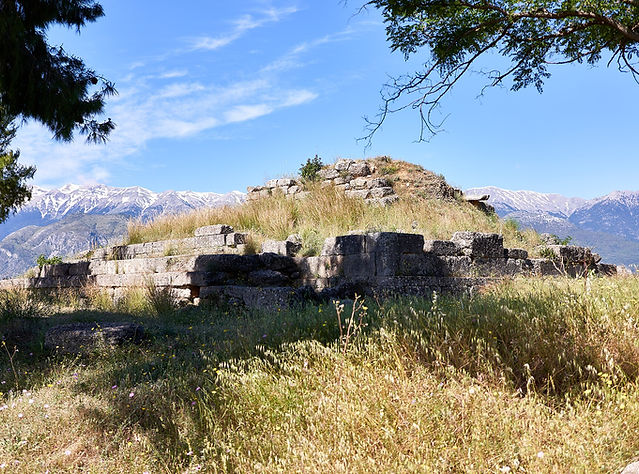
The monument visible today is a large rectangular platform built in stages, rising in steps like a great stone base. The earliest shrine dates from around the 8th or 7th century BC, and it was rebuilt on a grander scale in the early 5th century BC. On top probably stood a small temple. Offerings found here, including bronze objects, pottery and lead figurines, show that people worshipped at the site for centuries.
Some of those offerings carried inscriptions that settled any doubt about who was honored here. Among them was a bronze vessel dedicated to Helen and other objects naming Menelaus. These finds, uncovered by British archaeologists in the early 20th century and in later excavations, confirmed that the hill was indeed the sanctuary of the legendary couple described by ancient writers.
The hill has an even older story. Just below the shrine, archaeologists found the remains of a large Mycenaean building from the Late Bronze Age, the period in which the Trojan War legends are set. It was an important residence, and some have wondered whether it inspired the tradition of Menelaus's palace. Nobody can say for sure, but the discovery shows that the hill was a seat of power long before it became a shrine.
Today the Menelaion is a short drive from modern Sparta, followed by a walk up the hill. The site is usually quiet, and the climb is rewarded with one of the finest views in Laconia, across the green Eurotas valley to the town of Sparta and the rugged wall of Taygetus. Stand on the ancient platform at sunset and it is easy to imagine the Spartans gathering here to honor the king who went to Troy and the woman whose beauty launched a thousand ships.
Heroes Worshipped at the Menelaion
Frequently Asked Questions About the Menelaion
Who was honored at the Menelaion?
The shrine honored King Menelaus of Sparta and his wife Helen, whom the Spartans worshipped as a goddess. Ancient writers said both were buried there.
Where is the Menelaion?
It stands on a hill at ancient Therapne, on the east bank of the Eurotas River, a short drive from modern Sparta in the Peloponnese.
When was the Menelaion built?
The first shrine dates from around the 8th or 7th century BC, and it was rebuilt on a larger scale in the early 5th century BC.
How do we know the shrine belonged to Menelaus and Helen?
Offerings found at the site include inscriptions naming Helen and Menelaus, confirming the descriptions of ancient writers such as Pausanias.
Was there a palace at the Menelaion?
Below the shrine, archaeologists found remains of a large Mycenaean building from the Late Bronze Age, though it cannot be proven that it was Menelaus's palace.
What is the view like from the Menelaion?
The hill offers sweeping views over the Eurotas valley to Sparta and the peaks of Mount Taygetus, especially beautiful at sunset.
