


Portara: The Great Marble Gateway of Naxos

The Story of the Portara
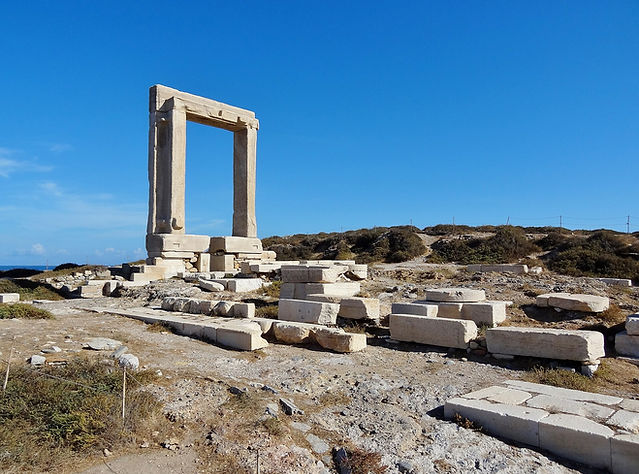
As ferries sail into the harbor of Naxos, the first thing passengers see is a colossal marble frame standing alone on a rocky islet, like a door to nowhere. The locals call it the Portara, meaning the great door. It is the entrance to a temple that was never completed, and it has stood on the islet of Palatia for some 2,500 years, joined today to the town by a stone causeway.
The temple was begun around 530 BC under Lygdamis, the tyrant of Naxos. At the time, Naxos was one of the wealthiest islands of the Cyclades, famous for its marble and its sculptors. Lygdamis wanted a grand Ionic temple to rival the great temples of Samos and Ephesus. It was planned to be about 59 meters long, with a ring of columns, but when Lygdamis was overthrown, work stopped. Only the foundations and the huge doorway of the inner chamber were completed.
The temple is usually thought to have been dedicated to Apollo, because its doorway faces toward Delos, the sacred island of the god. Some scholars have suggested it might have been intended for Dionysus, who was the patron god of Naxos. Each of the four parts of the doorway is a single block of marble weighing around 20 tons, and the door stands about 6 meters high.
Palatia is also linked with one of the most romantic myths of Naxos. After Theseus killed the Minotaur in Crete with the help of the princess Ariadne, he sailed away with her, but on the way to Athens he left her behind on Naxos while she slept. Local tradition says this happened on the islet of Palatia. Ariadne awoke to find herself alone, but Dionysus soon arrived, fell in love with her and made her his wife.
The unfinished temple had a long afterlife. In the early Christian period it was converted into a church, and later its marble was taken for new buildings. When the Venetians ruled Naxos from the 13th century, they removed much of the stone to build their castle on the hill above the harbor. The door frame, too massive to move, was left standing.
Despite all this, the Portara survived for two and a half millennia, exposed to the sea winds and the salt spray. Its scale is best appreciated up close, where you can see how the blocks were carved and fitted together without mortar. The foundations of the temple around it reveal the size of the building that was planned, and the scale of the ambition of Lygdamis and his island.
Today the Portara is the most famous landmark of Naxos and a short walk from the main town, Chora. Follow the causeway to the islet, walk through the giant doorway and look out over the sea toward the other Cycladic islands. The Portara is especially popular at sunset, when the sun sinks into the sea and is framed by the ancient marble, a moment that many visitors count among the most magical in the Cyclades.
Gods Linked to the Portara of Naxos
Frequently Asked Questions About the Portara
What is the Portara?
The Portara is the giant marble doorway of an unfinished temple begun around 530 BC on the islet of Palatia, at the entrance to Naxos harbor.
Who was the temple dedicated to?
It is usually thought to have been dedicated to Apollo, since the doorway faces toward Delos, though some scholars suggest it may have been meant for Dionysus.
Why was the temple never finished?
Construction began under the tyrant Lygdamis, and when he was overthrown, work stopped. Only the foundations and the doorway were completed.
How big is the Portara?
The doorway stands about 6 meters high, and each of its four parts is a single marble block weighing around 20 tons.
What is the connection between Naxos and Ariadne?
According to myth, Theseus left Ariadne on Naxos, and local tradition places this on Palatia. Dionysus then found her and made her his wife.
When is the best time to visit the Portara?
Many visitors come at sunset, when the sun sets over the sea and is framed by the marble doorway.
