


Sanctuary of Dionysus: The Birthplace of Theater

The Story of the Sanctuary of Dionysus
Every spring in ancient Athens, the city threw a festival unlike any other. It was dedicated to Dionysus, god of wine, ecstasy and fertility, and its heart was a sanctuary on the south slope of the Acropolis. Here, in a hollow beneath the sacred rock, the Athenians invented something that still shapes our world. They gathered on the hillside to watch actors in masks tell stories of gods and heroes, and in doing so they created the theater.
The sanctuary honored Dionysus Eleuthereus, named after Eleutherae, a town on the border between Attica and Boeotia. According to tradition, an old wooden statue of the god was brought from there to Athens. Every year during the festival of the City Dionysia, the statue was carried out of the city and then led back in a torchlit procession, reenacting the god's arrival. Two temples of Dionysus were built here over time, an older one from the 6th century BC and a later one that held a gold and ivory statue of the god.
The festival grew into a great celebration of the whole city. There were processions, sacrifices and choruses of singing and dancing men. Out of these choral songs grew tragedy, and in the 5th century BC the City Dionysia became the stage for formal drama competitions. Playwrights presented their works over several days, and judges chosen by lot awarded prizes. Citizens came from all over Attica, and allies of Athens came to pay their tribute and watch the shows.
The names of the winners are still famous. Aeschylus, Sophocles and Euripides, the three great tragedians, presented many of their plays here, among them works such as the Oresteia and Oedipus the King. Aristophanes made audiences laugh with his comedies, mocking politicians, philosophers and even the gods. Many of the stories, characters and ideas of Western drama first came to life on this hillside, before an audience sitting under the open sky.
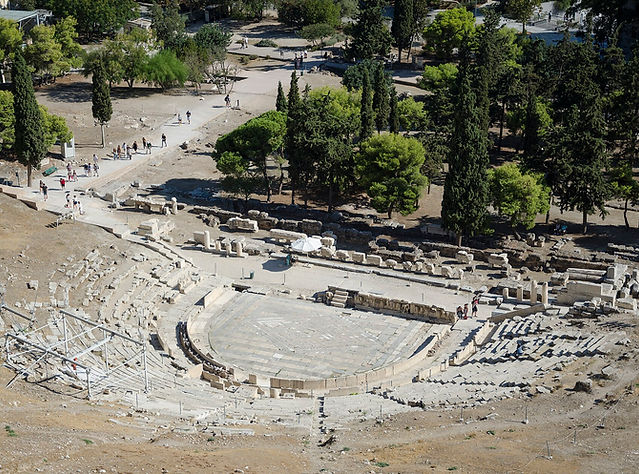
In the days of the great playwrights, the audience probably sat on simple wooden benches and earth. The stone theater whose remains you see today was built in the second half of the 4th century BC, under the Athenian statesman Lycurgus, and could hold many thousands of spectators. The front row was lined with marble thrones for priests and officials, and the finest seat in the middle belonged to the priest of Dionysus himself. Many of these carved thrones still survive, inscribed with the titles of the dignitaries who sat in them.
The theater kept changing over the centuries. The Romans remodeled the stage and orchestra, and in the later Roman period a raised platform decorated with reliefs of scenes from the life of Dionysus was added to the front of the stage. Parts of this carved frieze can still be seen today, showing the god among his followers. Later still, the theater was abandoned and gradually buried, until archaeologists uncovered it in the 19th century.
Today the Sanctuary of Dionysus is part of the archaeological site on the south slope of the Acropolis, close to the Acropolis Museum. You can sit on the ancient seats, look down at the marble orchestra floor and imagine the masked chorus dancing below. Spot the throne of the priest of Dionysus in the front row and the reliefs on the stage. Then look up toward the Parthenon on the rock above, and remember that the first audiences in history watched tragedy unfold in this very place.
Gods Worshipped at the Sanctuary of Dionysus
Frequently Asked Questions About the Sanctuary of Dionysus
Who was the Sanctuary of Dionysus dedicated to?
It was dedicated to Dionysus Eleuthereus, the god of wine, ecstasy and theater, whose old statue was said to have been brought to Athens from the town of Eleutherae.
What is the Theatre of Dionysus?
It is the ancient theater within the sanctuary, on the south slope of the Acropolis. It is considered the birthplace of Greek tragedy and comedy, where great playwrights competed during the festival of Dionysus.
Which plays were performed here?
Works by Aeschylus, Sophocles, Euripides and Aristophanes were performed here in the 5th century BC, during the festival called the City Dionysia.
When was the stone theater built?
The stone theater visible today was built in the second half of the 4th century BC under the statesman Lycurgus. It was later remodeled by the Romans.
What was the City Dionysia?
The City Dionysia was a major Athenian festival held every spring in honor of Dionysus. It included processions, sacrifices and drama competitions in which playwrights presented new plays.
Can you visit the Theatre of Dionysus?
Yes. It is part of the archaeological site on the south slope of the Acropolis in Athens, and visitors can walk among its seats and see the marble thrones of the front row.
