


Sanctuary of Zeus Olympios at Dion: Sacred City of the Macedonians

The Story of the Sanctuary of Zeus Olympios at Dion
At the foot of Mount Olympus, where streams flow down from the highest mountain in Greece toward the sea, lies Dion, the holy city of the ancient Macedonians. Its name comes from Zeus, known in Greek as Dias, and it was the natural place for the Macedonians to honor Zeus Olympios, the king of the gods who was believed to rule from the summit above. Among lush woods and springs, the city grew into the religious heart of the Macedonian kingdom.
In the late 5th century BC, King Archelaus of Macedon established a great festival at Dion in honor of Zeus and the Muses, with athletic and dramatic contests. The Muses were closely tied to the region of Pieria, said to be their birthplace. Archelaus was a great patron of Greek culture, and the playwright Euripides spent his last years at the Macedonian court.
Dion was closely linked with the rise of Macedonian power. King Philip II celebrated his victories here, and in 334 BC his son, Alexander the Great, offered sacrifices at Dion before leading his army into Asia. After his first great victory over the Persians at the Granicus River, Alexander commissioned the sculptor Lysippus to make bronze statues of the companions who had fallen in the battle, and these were set up at Dion. Centuries later, the Romans carried them off to Rome.
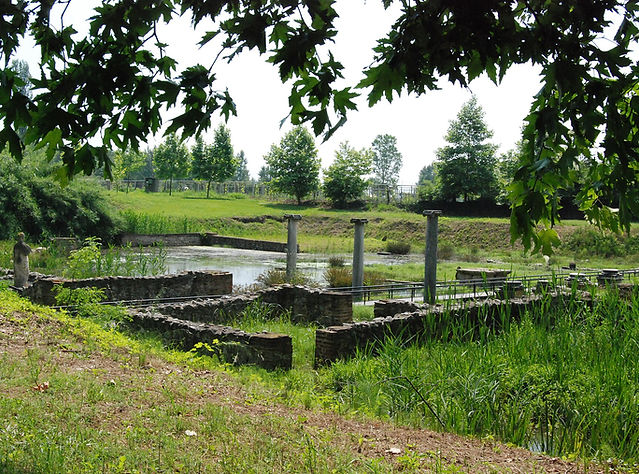
The sanctuary of Zeus Olympios was the city's most important, with a great altar where many animals could be sacrificed at once. Nearby lay one of the oldest sanctuaries of the area, dedicated to Demeter, the goddess of grain, where small temples date back to the Archaic period. There were also sanctuaries of Asclepius and, in Roman times, of the Egyptian goddess Isis, built beside a spring, where statues still stand reflected in the water.
Dion continued to flourish under the Romans, who founded a colony here. They built baths decorated with mosaics, a theater, a grand villa and streets lined with shops and workshops. But the city declined in late antiquity, struck by earthquakes and floods from the mountain streams. The marshy ground gradually swallowed the ruins, which helped preserve many of them beneath the mud.
Systematic excavations began in the 1970s under the archaeologist Dimitrios Pandermalis, and they continue to bring remarkable discoveries to light. Among the most famous is a hydraulis, an ancient water organ found in 1992, one of the oldest known musical instruments of its kind. Mosaics, statues and inscriptions found at Dion are displayed in the excellent local archaeological museum.
Today the Archaeological Park of Dion is one of the most beautiful ancient sites in northern Greece, where ruins mingle with streams, reeds and trees, and the peaks of Mount Olympus rise above. Walk through the sanctuaries of Zeus, Demeter and Isis, see the Roman baths and mosaics, and visit the museum in the village. Dion is easy to combine with a trip to Litochoro and a hike in Olympus National Park, completing a journey to the home of the gods.
Frequently Asked Questions About the Sanctuary of Zeus Olympios at Dion
Who was worshipped at Dion?
Dion's main sanctuary honored Zeus Olympios. The city also had sanctuaries of Demeter, Asclepius, the Muses and, in Roman times, the Egyptian goddess Isis.
Why is Dion called the sacred city of the Macedonians?
Dion was the religious center of the ancient Macedonian kingdom, where kings held festivals and sacrifices to Zeus at the foot of Mount Olympus.
What is the connection between Dion and Alexander the Great?
Alexander offered sacrifices at Dion in 334 BC before his campaign against Persia, and he later had statues of fallen companions set up there.
What is the hydraulis of Dion?
It is an ancient water organ discovered at Dion in 1992, one of the oldest known instruments of its kind.
Who excavated Dion?
Systematic excavations began in the 1970s under the archaeologist Dimitrios Pandermalis and have continued since.
Where is Dion?
Dion is in Pieria, in Central Macedonia, at the foot of Mount Olympus, a short drive from the town of Litochoro.
