


Temple of Apollo Zoster: Leto's Resting Place by the Sea

The Story of the Temple of Apollo Zoster
Today the coast south of Athens is lined with beach clubs, marinas and luxury hotels, and few people realize that one of its beaches hides an ancient sanctuary. At Vouliagmeni, on the small peninsula of Laimos, lie the remains of a temple to Apollo Zoster. The name comes from a cape that the ancient Greeks called Zoster, meaning girdle or belt, and the story behind it reaches back to the birth of the god himself.
According to myth, Leto was pregnant with the twins of Zeus, but the jealous Hera made sure no land would let her give birth. Leto wandered from place to place, until finally the floating island of Delos accepted her. The people of Attica told that on her journey Leto stopped at this cape and loosened her girdle, a sign that the birth was near. The travel writer Pausanias, who passed this way in the 2nd century AD, mentions altars here to Athena, Apollo, Artemis and Leto.
The cape also appears in the history of the Persian Wars. The historian Herodotus tells that after the Greek victory at Salamis in 480 BC, the retreating Persian fleet sailed past Zoster at night. Seeing the small rocky points sticking out into the sea, the sailors mistook them for enemy ships and fled in panic. It is a vivid reminder of how frightening the Greek navy had become after its great triumph.
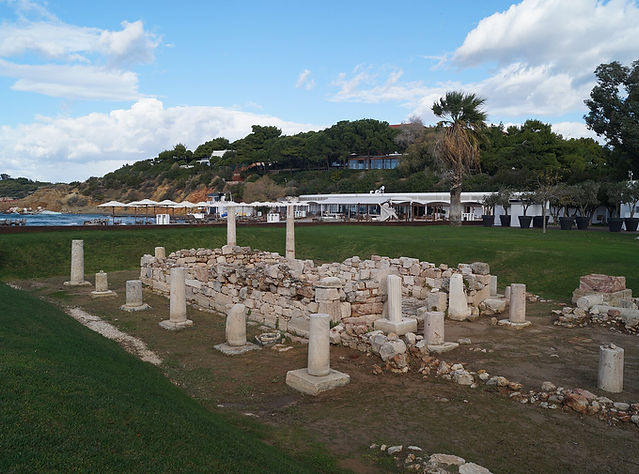
The temple itself is modest. It was a small rectangular building of the Archaic period, later repaired and altered over the centuries. Inside, archaeologists found the base that once held the cult statue, along with other stone fittings used in worship. In front of the temple stood an altar, where sacrifices were offered, and nearby were the remains of buildings that probably served the priests and the visitors who came to honor the god by the sea.
Like many sanctuaries on the Attic coast, the Temple of Apollo Zoster was largely forgotten for centuries. It was rediscovered in the 1920s, when the ruins were uncovered and excavated by Greek archaeologists. Inscriptions found at the site confirmed it was a sanctuary of Apollo Zoster, and pottery and offerings showed that worshippers had come here for hundreds of years.
The setting has changed dramatically since antiquity. Instead of fishermen and pilgrims, the peninsula is now part of a famous resort area, and the ruins sit near the sand of a popular beach. Yet the location still makes sense: the sea is calm and clear, the coastline gentle, and the cape still looks out over the Saronic Gulf toward the islands, as it did when Leto supposedly rested here.
Today the Temple of Apollo Zoster is a curious stop for anyone exploring the Athens Riviera, about 20 kilometers south of the city center. The foundations are low and simple, so come for the story and the setting rather than towering columns. Combine a look at the ruins with a swim in the sea or a visit to the nearby Lake Vouliagmeni, and enjoy a spot where myth, history and modern beach life sit side by side.
Gods Worshipped at the Temple of Apollo Zoster
Frequently Asked Questions About the Temple of Apollo Zoster
Who was the Temple of Apollo Zoster dedicated to?
It was dedicated to Apollo Zoster, and the sanctuary also honored his sister Artemis and his mother Leto. Pausanias mentions altars there to Athena, Apollo, Artemis and Leto.
What does Zoster mean?
Zoster means girdle or belt. According to legend, Leto loosened her girdle at this cape on her journey to Delos, where she gave birth to Apollo and Artemis.
When was the Temple of Apollo Zoster built?
The small temple dates from the Archaic period and was used, repaired and modified over several centuries.
What is the Persian Wars story about Zoster?
Herodotus writes that the Persian fleet, retreating after the Battle of Salamis in 480 BC, mistook the rocky points of Zoster for Greek warships and fled in panic.
When was the temple discovered?
The ruins were uncovered and excavated by Greek archaeologists in the 1920s.
Where is the Temple of Apollo Zoster?
It is on the Laimos peninsula at Vouliagmeni, on the Athens Riviera, about 20 kilometers south of central Athens, close to the beach.
