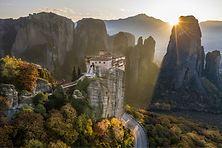
Meteora

Meteora rises on rock pillars crowned with centuries-old monasteries.
Intro
Meteora is one of Greece’s most extraordinary destinations, where immense sandstone rock pillars rise dramatically from the plains of Thessaly and centuries-old monasteries appear almost impossibly balanced on their summits. Located beside the towns of Kalambaka and Kastraki, Meteora combines remarkable geology with one of the most important centers of Eastern Orthodox monasticism in Greece. Six historic monasteries remain active and open to visitors today, while hiking trails, viewpoints, caves, and hermitages reveal a landscape that extends far beyond the famous postcard views. Recognized as a UNESCO World Heritage Site, Meteora offers a completely different experience from Greece’s ancient cities and islands.
Who It’s Best For
Meteora is particularly well suited for travelers interested in history, religion, nature, photography, and hiking. The monasteries provide an extraordinary introduction to Orthodox Christian history and Byzantine tradition, while the surrounding rock formations make the area one of mainland Greece’s most distinctive natural landscapes. Photographers and couples will find spectacular viewpoints throughout the region, particularly around sunrise and sunset, while active travelers can explore trails connecting monasteries, caves, forests, and the villages below. Meteora is also an excellent addition to a larger mainland itinerary connecting Athens, Thessaly, and Thessaloniki.
Who It’s Best For: A Quick Breakdown
Traveler Type | Why They’ll Love Meteora |
History & Culture Lovers | Centuries-old monasteries preserve religious art, manuscripts, architecture, and the traditions of Orthodox monastic life. |
Nature Lovers | Enormous sandstone pillars, forests, caves, and dramatic viewpoints create one of Greece’s most unusual landscapes. |
Hikers & Outdoor Travelers | Trails connect monasteries, hermitages, rock formations, and villages throughout the Meteora landscape. |
Photographers | Changing light, elevated viewpoints, monasteries, and towering rock formations provide exceptional photography throughout the day. |
Road Trippers | Fits naturally into a larger journey through central and northern mainland Greece, particularly between Athens and Thessaloniki. |
Things to Know
Meteora is not a single attraction but an entire landscape containing multiple monasteries, viewpoints, trails, and historic religious sites. Six monasteries remain active and can be visited, but their opening days and hours vary. Individual monasteries may close on different days of the week, so travelers hoping to visit several should check schedules before planning their itinerary.
Visitors must also follow dress requirements when entering the monasteries. Shoulders and knees should be covered, and individual monasteries may provide wraps or coverings when necessary. These are active religious communities rather than museums alone, so visitors should behave respectfully and follow any photography restrictions inside churches and monastic spaces.
You do not need to be an experienced hiker to experience Meteora. Roads connect the major monasteries and viewpoints, making the landscape accessible by car, taxi, or organized tour. However, walking at least part of Meteora provides a completely different perspective and reveals smaller religious sites, forests, caves, and viewpoints that are easy to miss from the road.
Things To Do
Visit the Great Meteoron Monastery to explore the largest and oldest of Meteora’s active monasteries, positioned high above the surrounding landscape.
Explore Varlaam Monastery to discover one of Meteora’s most impressive monastic complexes, with historic frescoes, religious artifacts, and dramatic views.
Visit the Monastery of Roussanou to see one of the most photogenic monasteries in Meteora, perched on a narrow rock formation surrounded by towering cliffs.
Explore the Monastery of Agios Stefanos to visit one of the most accessible monasteries and enjoy sweeping views across the Thessalian Plain.
Visit the Monastery of the Holy Trinity to experience one of Meteora’s most dramatically positioned monasteries after climbing the pathway and steps carved into the landscape.
See the Monastery of Agios Nikolaos Anapafsas to explore a compact monastery built vertically into the limited space available on its rocky summit.
Watch the Sunset Over Meteora to see the rock formations and monasteries transform as the evening light spreads across the landscape.
Hike Between the Monasteries to follow historic paths once used by monks and local residents through forests, rock formations, and hidden corners of Meteora.
Explore the Hermit Caves to discover the smaller caves and religious sites where monks lived in isolation long before the great monasteries were constructed.
Walk Through Kastraki to experience the traditional village sitting directly beneath Meteora’s enormous rock pillars.
Explore Kalambaka to visit the area's main town, with restaurants, cafés, shops, accommodation, and views toward the surrounding cliffs.
Visit the Byzantine Church of the Dormition of the Virgin Mary to see one of the area's most important religious monuments, built on a historic site overlooking Kalambaka.
These experiences reveal Meteora as far more than a collection of monasteries. The combination of religious history, hiking trails, villages, caves, viewpoints, and extraordinary geology makes the entire landscape worth exploring rather than simply driving between the most famous sites. For even more ways to experience the area, browse the activities, tours, and excursions that you can book in Meteora.
Areas to Explore
Great Meteoron & Varlaam occupy some of the highest and most dramatic rock formations and contain two of Meteora’s largest and most historically important monasteries.
Roussanou sits within one of the most photographed sections of Meteora, surrounded by towering rock pillars and dramatic viewpoints.
Agios Stefanos & Holy Trinity rise above Kalambaka and provide exceptional views across the town and the vast Thessalian Plain.
Kastraki is the small village immediately beneath the Meteora rocks, offering traditional guesthouses, tavernas, walking routes, and remarkably close views of the formations.
Kalambaka is the main town serving Meteora, providing the area's largest concentration of hotels, restaurants, shops, transportation, and visitor services.
The Meteora Viewpoints are scattered along the roads connecting the monasteries and provide some of the best panoramic views across the rock formations and surrounding plain.
Hermit Caves & Smaller Religious Sites preserve an earlier chapter of Meteora’s monastic tradition and can be found throughout the cliffs and lower rock formations.
The Thessalian Plain spreads dramatically below Meteora, creating the enormous open landscape that makes the vertical rock pillars appear even more striking.
Together, these areas demonstrate why Meteora should be experienced as a complete landscape rather than a single attraction, with monasteries, villages, trails, caves, and viewpoints all contributing to its character.
Beaches or Nature
Nature is inseparable from the Meteora experience. The region’s enormous sandstone and conglomerate rock formations rise hundreds of meters above the surrounding Thessalian landscape, creating sheer cliffs, isolated pillars, narrow valleys, caves, and natural passages. Their unusual shapes were formed through millions of years of geological processes and erosion, eventually producing the landscape visible today.
Forests and vegetation fill the spaces between the rocks, while trails weave through the lower slopes and connect villages with monasteries and historic religious sites. The open Thessalian Plain stretches outward beneath the formations, creating particularly dramatic views around sunrise, sunset, and changing weather. Meteora has no coastline, but for travelers interested in mountains, geology, hiking, and dramatic scenery, it offers one of the most memorable natural environments in Greece.
Local Cuisine
The cuisine around Meteora draws heavily from the traditions of Thessaly and central mainland Greece, with meals built around local meats, cheeses, vegetables, pies, grains, and seasonal produce. Traditional tavernas in Kalambaka and Kastraki commonly serve grilled lamb and other meats, slow-cooked dishes, handmade pies, legumes, and recipes associated with the surrounding mountain and agricultural communities.
Feta and other regional cheeses feature prominently, while savory pies filled with greens, cheese, or meat are characteristic of Thessalian cooking. Local wines and tsipouro also accompany meals throughout the region. Kastraki can be particularly enjoyable for a relaxed dinner beneath the Meteora rocks, where the setting becomes part of the experience as the cliffs darken above the village after sunset.
History
The unusual caves and rock formations of Meteora attracted religious hermits long before the construction of its famous monasteries. By around the 11th century, ascetic monks were living in caves and small hermitages among the cliffs, seeking isolation and spiritual contemplation within the remote landscape.
Organized monastic life expanded significantly during the 14th century, when Saint Athanasios Meteorites established a community on the rock known as the Great Meteoron. As political instability and conflict affected surrounding regions, the inaccessible rock pillars offered monks both isolation and protection. Over time, monasteries were constructed on numerous summits throughout Meteora.
Reaching these monasteries was once extraordinarily difficult. Monks, supplies, and visitors could be raised using ropes, nets, ladders, and pulley systems, emphasizing the isolation of the communities above. At its height, Meteora contained more than twenty monasteries, although only six active monasteries survive today.
The monasteries preserved important frescoes, manuscripts, icons, religious objects, and traditions through centuries of political change. Meteora's combination of cultural, religious, historical, and natural significance led to its designation as a UNESCO World Heritage Site in 1988, securing its place among Greece’s most important destinations.
Best Time to Visit
Meteora is particularly enjoyable during April through June and September through October, when temperatures are generally comfortable for hiking, climbing monastery steps, and spending long periods outdoors. Spring brings green vegetation and wildflowers around the rock formations, while early autumn often provides clear skies and warm days without the most intense summer heat.
July and August are the busiest and hottest months. The monasteries and main viewpoints can become crowded during the middle of the day, particularly when tour groups arrive. Visiting early in the morning and remaining through the late afternoon provides a quieter experience and allows you to see how dramatically the landscape changes with the light.
Winter creates an entirely different atmosphere. Visitor numbers fall considerably, and snow occasionally covers the monasteries and rock formations, creating some of Meteora’s most dramatic scenery. Days are shorter and weather can affect hiking plans, but travelers interested in photography, solitude, and the religious character of the monasteries may find winter especially rewarding.
Editor's Insider Tips
Do not try to visit all six monasteries as quickly as possible simply to check them off a list. After several rushed monastery visits, the experience can begin to blur together. Choose a few that interest you most, spend time inside them, and leave enough room in your schedule to experience the landscape itself.
Stay for at least one sunset. Many day visitors leave Meteora before evening, but the changing light across the rocks is one of the defining experiences of the region. The roadside viewpoints between the monasteries provide extraordinary views without requiring a serious hike.
If your schedule allows, spend two nights rather than treating Meteora as a rushed day trip from Athens. The distance is significant, and staying overnight allows you to experience the area early in the morning and after the largest groups have departed. It also gives you time to explore Kastraki, hike through the landscape, and visit monasteries at a more relaxed pace.
Finally, get out of the car. Even a relatively short walk through the trails beneath the rock formations changes the scale of Meteora completely. From below, the cliffs and monasteries feel dramatically larger, and you begin to understand why monks chose this landscape for isolation more than a thousand years ago.
Browse Tours and Activities near Meteora