Greece Says It Will Not Ask Turkey's Permission for Cyprus Power Cable

Greece drew a firm line on Monday over its undersea power link with Cyprus: Athens did not ask Turkey for permission to restart work on the project, and it will not. Government spokesman Pavlos Marinakis said the licensing is complete, a navigational warning is in force, and the French survey ship hired for the job is getting ready to leave Crete.

The project is the Great Sea Interconnector (GSI), a planned electricity cable under the eastern Mediterranean that would connect the grid of Crete with Cyprus. Seabed surveys along its route stalled in 2024 amid objections from Ankara, and the restart has become one of the biggest stories in Greece this week, sharing front pages with reports about a French diplomatic note to Turkey.
What Greece Approved on November 6
According to an announcement by the Hellenic Foreign Ministry, the licensing followed an application from the French cable company Nexans, filed on behalf of GSI, the company that owns the project. After a favorable opinion from the interministerial committee that grants marine survey permits, Foreign Minister Giorgos Gerapetritis signed the decision on November 6. It authorizes both survey work and cable-laying operations.
The survey vessel then asked for a NAVTEX, the formal notice that warns ships about special operations in an area, and the Hellenic Navy Hydrographic Service issued it right away. Kathimerini reported that the Greek notice, NAVTEX 1411/26, is valid until March 6, 2027. Cyprus issued its own warning for its part of the route.
A Permit Is One Thing, Notification Is Another
At his regular briefing for political reporters on Monday, Marinakis said permission was requested only from the Greek and Cypriot authorities. "It has not been, and will not be, sought from Turkey," he said, adding that there is no agreement or coordination between Athens and Ankara on licensing the project.
Much of the debate in Athens over the weekend focused on a written communication that France sent to Turkey, described in Greek media as a note verbale. The ship doing the surveys, the Abeille Marengo, sails under the French flag. Opposition parties and some outlets argued that the note amounted to asking for Ankara's consent. Marinakis rejected that reading. "A permit is one thing, and notification is another," he said, calling the note the mildest form of contact between states. He said it was purely informational, concerned the safety of navigation, contained no geographic coordinates, and does not recognize any Turkish maritime jurisdiction or rights.
He also said Greece had received no intervention from the United States over the project, and that he was not aware of any contact on it between Gerapetritis and Turkish Foreign Minister Hakan Fidan. Earlier in the day, Environment and Energy Minister Stavros Papastavrou made the same point in an interview with MegaNews radio. "The only country to grant permission by issuing a NAVTEX is Greece," he said, adding that any notification from France cannot be considered, directly or indirectly, a request for permission.
How Turkey Responded
Ankara answered the Greek notice with a counter-NAVTEX of its own, numbered 1105/26 according to Kathimerini. In a statement on November 6, the Turkish Foreign Ministry described the planned work as unauthorized marine research linked to cable-laying on what Turkey considers its continental shelf. It said Turkey had cancelled the Greek and Cypriot warnings and that the authorization it says is required from Turkey for that part of the work had not yet been completed.
Athens says the counter-NAVTEX has no legal effect and repeats familiar Turkish claims. Fidan struck a calmer tone over the weekend: asked by SKAI about the cable and the exchange of notices, he said everything was normal and fine. Greek media read that as an effort to lower tensions, but Turkey has not withdrawn its counter-notice or dropped its claims.
Where the Survey Ship Stands
The Abeille Marengo, chartered by Nexans, has been docked in Heraklion, Crete, since October 27. As of Monday afternoon in Greece, local media in Heraklion reported that it had not yet sailed, and that its departure was expected within 24 hours, most likely on Tuesday, November 10. Its first miles at sea will be used to calibrate its sonar and other seabed mapping instruments.
From there, it is expected to head to the waters southeast of Karpathos and survey the seabed as far as 12 nautical miles from Cyprus. The geometric and geological surveys are meant to find the safest route for laying the cable on the sea floor. This includes the area east of Kasos where surveys were interrupted in the summer of 2024 amid tension between Greece and Turkey. Greek reports say about 60% of the marine surveys between Greece and Cyprus are already done, and that the remaining stretch could take four to six months. The ship's job is to survey the route, not to lay cable.
Why the Cable Matters
The GSI is designed as a high-voltage direct current link running about 900 kilometers under the sea, with an initial capacity of 1,000 megawatts in both directions, according to the project's website. It would end the electricity isolation of Cyprus, the last EU member state without a connection to the European grid. The EU has listed it as a Project of Common Interest since 2013 and awarded it €657 million from the Connecting Europe Facility in 2022. The wider plan also foresees a later extension from Cyprus to Israel.
Greece's power grid operator IPTO took over the project in 2023, and in August 2026 French infrastructure investor Meridiam became the majority shareholder in GSI. The cost is often put at €1.9 billion, but the head of Cyprus's energy regulator told lawmakers in October that the final price cannot yet be reliably estimated and could rise if the surveys require a new route. He also said completion now looks likely in January 2031, a year later than first planned.
Papastavrou said the cable's strategic value lies in ending the energy isolation of Cyprus and strengthening Europe's energy integration. Marinakis called it a project of strategic importance for energy self-sufficiency and regional stability.
What to Watch Next
The next test is at sea. Once the Abeille Marengo leaves Heraklion, attention will turn to whether the surveys east of Kasos go ahead without interference, as Athens expects, or whether Turkish naval moves slow them down, as happened in 2024. Kathimerini noted that the work could begin while Turkey hosts the COP31 climate conference in Antalya, which runs from November 9 to 20.
Marinakis said the Foreign Ministry will brief Greece's political parties at the appropriate time, and insisted that the project is moving ahead as planned.
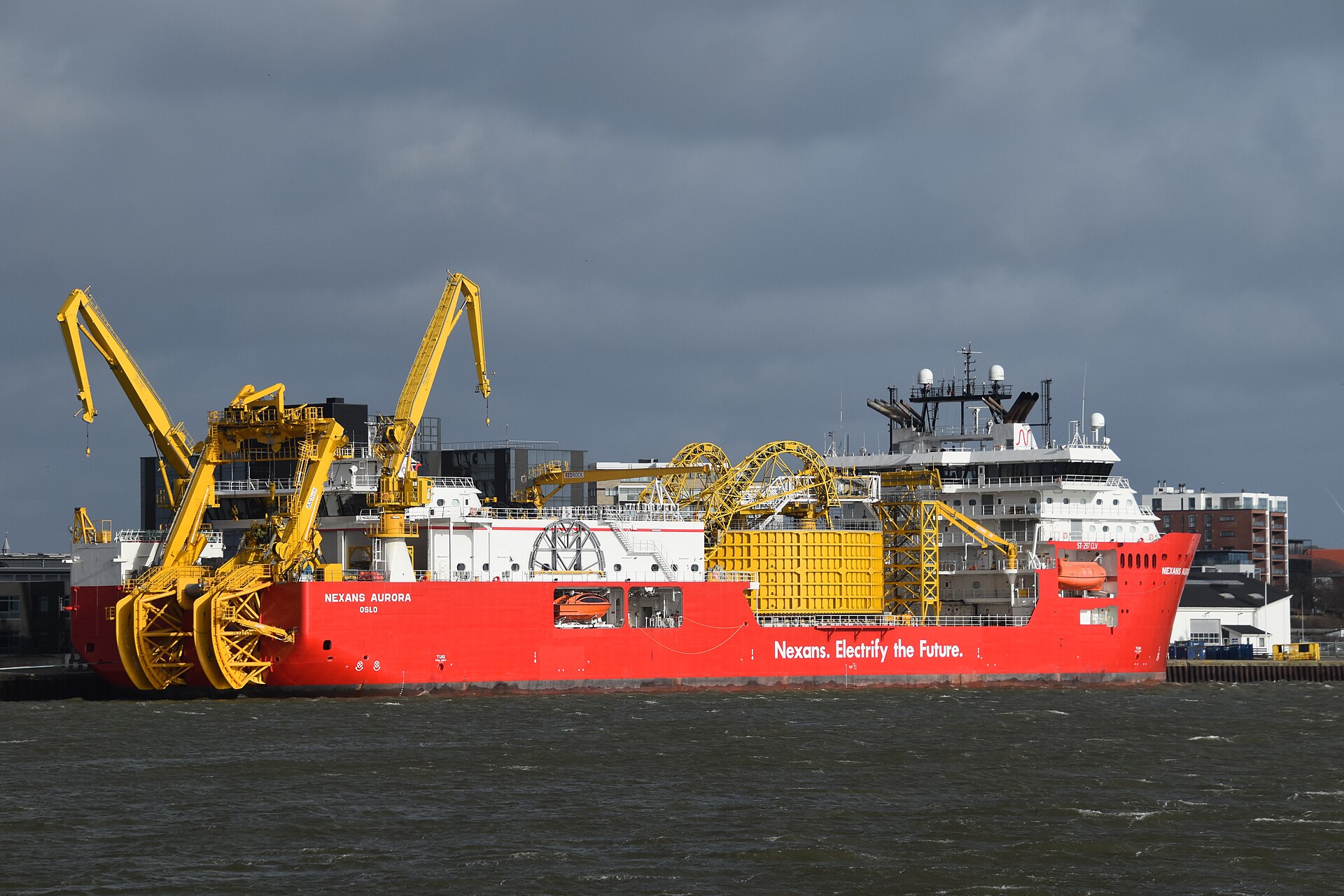
Photo: Nexans Aurora cable ship in Esbjerg, Denmark, by Thomas Dahlstrøm Nielsen, CC BY 4.0, via Wikimedia Commons